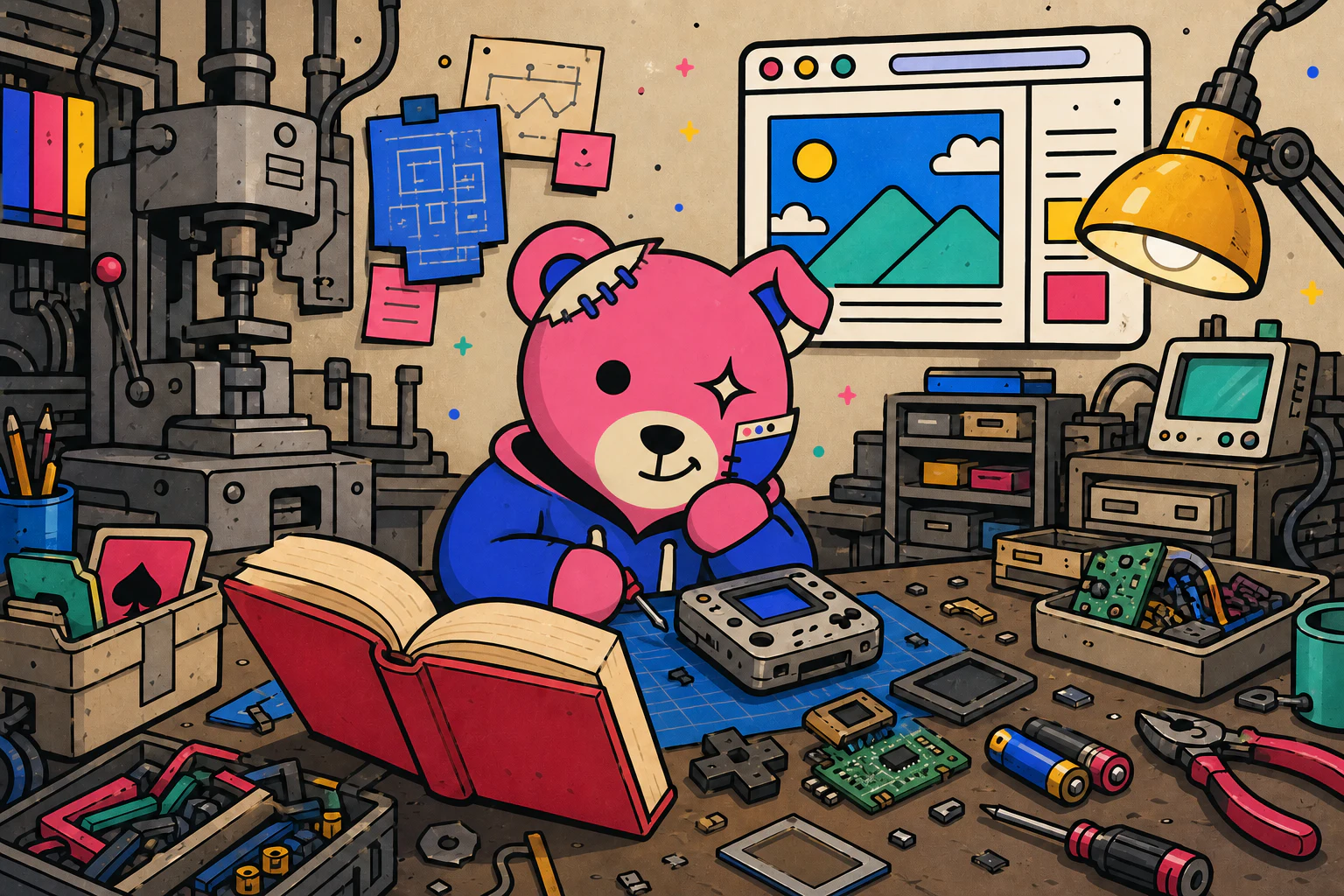
I reread Basecamp’s Getting Real this week expecting a nostalgia trip through mid-2000s web thinking. Instead I kept running into the sense that I’d read it before, in Japanese, about hardware.
The other voice in my head belongs to Gunpei Yokoi, and the two of them have been arguing up there for years.
The repairman
Nintendo hired Yokoi in 1965 to maintain the machines on their assembly line, which at the time meant playing card presses. The company had spent its first eight decades printing hanafuda decks in Kyoto.
He got noticed building a toy out of spare parts during downtime, an extending grabber arm. Nintendo’s president saw it, put it into production as the Ultra Hand, and it sold over a million units. A maintenance engineer accidentally invented the toy division.
Then the Game & Watch. Yokoi was on the bullet train watching a bored businessman fiddle with an LCD calculator, and while the industry chased bigger and more powerful, he looked at the cheapest screen technology on earth and saw a game machine. Calculator parts, nearly free by 1980, became the product line that paid off Nintendo’s debts. The units were too thin for a joystick, so he invented the D-pad, and every controller you’ve held since carries that workaround.
He called it “lateral thinking with withered technology”: take mature, cheap, thoroughly understood parts and find the sideways idea nobody else sees in them. The Game Boy was the masterpiece. On paper it was a joke next to the Sega Game Gear and the Atari Lynx, a pea-soup monochrome screen against full color, but those machines ate six AA batteries in a few hours. The Game Boy ran 30-plus hours on four, cost half as much, and had Tetris. It outsold every color competitor by an order of magnitude.

Where they agree
The first real chapter of Getting Real is “Build Less,” and it argues that matching competitors feature for feature is a defensive, paranoid way to work. It lands on a line I’ve been repeating all week: “Instead of outdoing, try underdoing.”
That reminded me of the Game Boy.
Chapter 13 is “Embrace Constraints”: limited time and money and people force the clarity that abundance destroys. Yokoi would have nodded, then made it worse.
Where Yokoi goes further
Getting Real treats constraints as weather. You’re small, you’re broke, you have three people, so make a virtue of it. But Yokoi had Nintendo’s money and Nintendo’s factories and picked the worse screen anyway. Choosing scarcity you could afford to avoid is a harder discipline than making peace with the scarcity you’ve got, and it’s the version I keep failing at.
The book helps me choose how much to build; Yokoi helps me choose the materials. Mature parts are affordable and well documented. In software, a familiar framework can save me the work of keeping up with constant changes. Getting Real tells you to build less software. Yokoi tells you to build it out of proven junk.
And where the book says have an enemy and picks Microsoft Project, Yokoi refused to fight Sega on Sega’s terms. He moved the contest to battery life and price, which meant he wasn’t losing the color-depth race, he was ignoring it. Naming an enemy gives you marketing. Picking the axis gives you the win.
Where the book goes further
Yokoi’s philosophy is a design ethic, and design ethics say nothing about what happens after the thing is designed.
The back half of Getting Real is everything he never had to think about, because Nintendo had distribution. Teach instead of advertise. Answer your own support mail so you feel what you shipped. Write the copy yourself, since every button label is a design decision. Yokoi could hand a brilliant object to a machine that would put it in every store in Japan. Nobody reading this has that, and earning the attention yourself is now most of the job.
His story demands one more correction. He didn’t only make the Game Boy, he also made the Virtual Boy, a red monochrome headache that flopped hard enough to end his Nintendo career. Withered technology plus a sideways idea can absolutely produce a machine nobody wants. And the lateral thinking half is the half you can’t systematize, because it takes knowing a mature technology deeply enough to see what everyone else missed in it. That takes years.
What I carry
Choose the constraints and build something smaller with tools I understand. Explain it plainly and answer my own mail.
I got something useful from both.

END OF TRANSMISSION · FILE SAVED
The book snaps shut.
The repair bench stays open. Teddy has filed this one under PROVEN JUNK / KEEP FOREVER.
ONE-TAP PRIVATE SIGNAL
What kind of noise did this make?
One click sends Nick a tiny private light on the console. No account, count, leaderboard, or public performance.

INCOMING TRANSMISSION
What useful constraint are you choosing on purpose?
Send Teddy a note about The Repairman and the Book. It goes straight to Nick’s normal email inbox. No admin screen and no public comment thread.
KEEP THE RECEIVER ON · RSS ↗